nf-core/epitopeprediction
A bioinformatics best-practice analysis pipeline for epitope prediction and annotation
Introduction
nf-core/epitopeprediction is a bioinformatics pipeline that predicts which peptides bind to MHC molecules. It accepts three types of input:
- Somatic variants (VCF). The pipeline generates the mutant peptides and predicts candidate neoepitopes.
- Proteins (FASTA). The pipeline cuts each protein into peptides and finds the regions that bind.
- Peptides (TSV), for example from immunopeptidomics. The pipeline predicts binding for each peptide.
The pipeline supports these prediction tools:
- MHCflurry (
mhcflurry) - MHCnuggets (
mhcnuggets,mhcnuggetsii) - NetMHCpan and NetMHCIIpan (
netmhcpan,netmhciipan) - MixMHCpred and MixMHC2pred (
mixmhcpred,mixmhciipred)
The default tool is mhcnuggets. NetMHCpan, NetMHCIIpan, MixMHCpred and MixMHC2pred have their own licenses. The usage documentation tells you how to use them.
The pipeline is built using Nextflow, a workflow tool to run tasks across multiple compute infrastructures in a very portable manner. It uses Docker/Singularity containers making installation trivial and results highly reproducible. The Nextflow DSL2 implementation of this pipeline uses one container per process which makes it easier to maintain and update software dependencies. Where possible, these processes have been submitted to and installed from nf-core/modules in order to make them available to all nf-core pipelines, and to everyone within the Nextflow community!
On release, automated continuous integration tests run the pipeline on a full-sized dataset on the AWS cloud infrastructure. This ensures that the pipeline runs on AWS, has sensible resource allocation defaults set to run on real-world datasets, and permits the persistent storage of results to benchmark between pipeline releases and other analysis sources. The results obtained from the full-sized test can be viewed on the nf-core website.
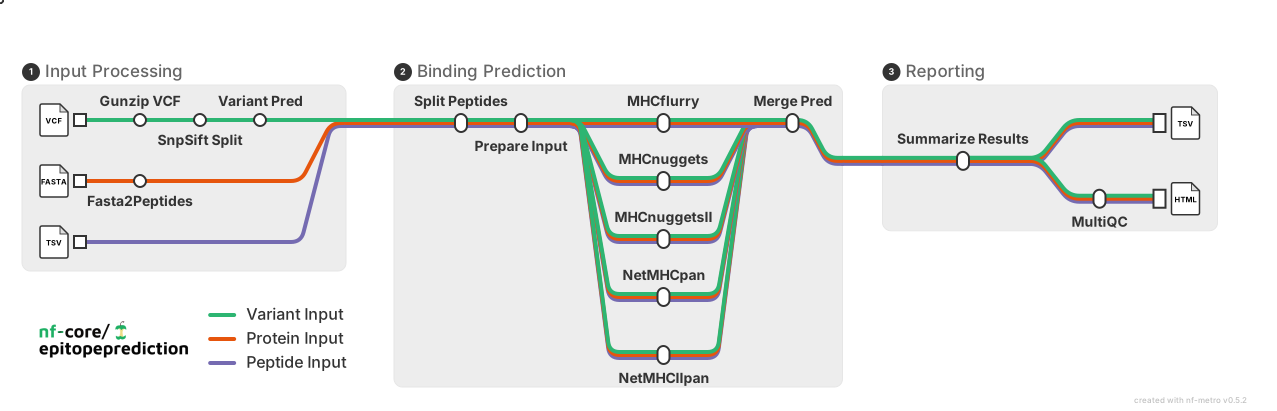
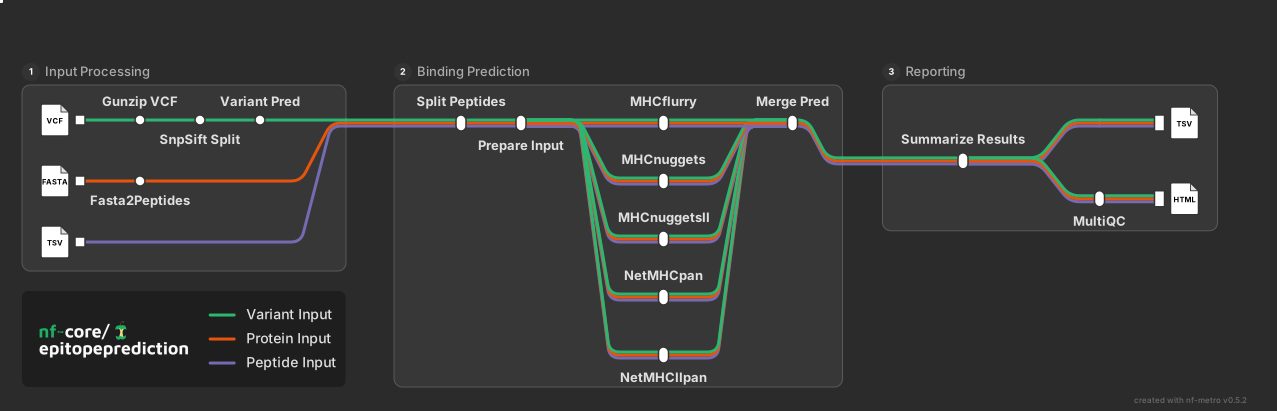
Pipeline summary
- Generate peptides from the input:
- Variants: filter and normalize the VCF (
bcftools), annotate it (Ensembl VEP) and build mutant protein sequences (pVACtools). - Proteins: cut each protein into peptides of the requested lengths.
- Peptides: use the peptides as given.
- Variants: filter and normalize the VCF (
- Predict MHC binding of each peptide for the alleles of the sample.
- Combine the results of all prediction tools into one table per sample.
- Summarize the binding statistics in a MultiQC report.
Usage
If you are new to Nextflow and nf-core, please refer to this page on how to set-up Nextflow. Make sure to test your setup with -profile test before running the workflow on actual data.
First, prepare a samplesheet with your input data that looks as follows:
samplesheet.csv:
sample,alleles,mhc_class,filenameGBM_1,A*01:01;A*02:01;B*07:02;B*24:02;C*03:01;C*04:01,I,gbm_1_variants.vcfGBM_2,A*01:01;A*24:02;B*07:02;B*68:01;C*07:02;C*15:01,I,gbm_2_proteins.fastaGBM_3,A*02:01;A*24:01;B*07:02;B*08:01;C*04:01;C*07:01,I,gbm_3_peptides.tsvEach row gives one input file, the sample it belongs to, its alleles and the MHC class to predict.
Now, you can run the pipeline using:
nextflow run nf-core/epitopeprediction \ -profile <docker/singularity/.../institute> \ --input samplesheet.csv \ --outdir <OUTDIR>Variant input also needs a VEP cache and a genome FASTA. See Reference data.
Please provide pipeline parameters via the CLI or Nextflow -params-file option. Custom config files including those provided by the -c Nextflow option can be used to provide any configuration except for parameters; see docs.
For more details and further functionality, please refer to the usage documentation and the parameter documentation.
Pipeline output
To see the results of an example test run with a full size dataset refer to the results tab on the nf-core website pipeline page. For more details about the output files and reports, please refer to the output documentation.
Credits
nf-core/epitopeprediction was originally written by Christopher Mohr and Alexander Peltzer. Further contributions were made by Sabrina Krakau and Leon Kuchenbecker.
The pipeline was converted to Nextflow DSL2 by Christopher Mohr, Marissa Dubbelaar, Gisela Gabernet, and Jonas Scheid and further modularized by Jonas Scheid and Alina Bauer.
Contributions and Support
If you would like to contribute to this pipeline, please see the contributing guidelines.
For further information or help, don’t hesitate to get in touch on the Slack #epitopeprediction channel (you can join with this invite).
Citations
If you use nf-core/epitopeprediction for your analysis, please cite it using the following doi: 10.5281/zenodo.3564666
An extensive list of references for the tools used by the pipeline can be found in the CITATIONS.md file.
You can cite the nf-core publication as follows:
The nf-core framework for community-curated bioinformatics pipelines.
Philip Ewels, Alexander Peltzer, Sven Fillinger, Harshil Patel, Johannes Alneberg, Andreas Wilm, Maxime Ulysse Garcia, Paolo Di Tommaso & Sven Nahnsen.
Nat Biotechnol. 2020 Feb 13. doi: 10.1038/s41587-020-0439-x.